TU Dresden’s Chair of Digital Cultures along with the Chair of Micro-Sociology and Techno-Social Interaction and Department for Speculative Transformation hosted a research studio focused on the energy transition in Lusatia, Germany, recently. This research studio preceded the German STS conference Leakage. I was a participant in the first four days of the research studio which brought us to an open-pit lignite mine at Welzow-Süd, a solar park at Welzow and an energy museum (Energiefabrik Knappenrode) and a tour of the Center for Energy Technology at TU Dresden. We also had a visit to Cottbuser Ostsee where the refurbishment of an exhausted mine into a large lake was the center of urban redevelopment plans projected for the next 10 to 20 years. These visits were prefaced by lectures on Critical Mapping by Leon Jank, Pauline Mai and Louisa Scherer from TU Dresden, and on the urban planning and redevelopment dynamics of the region by Robert Knippschild.

Sisyphean sculpture at an exhausted mine which is being renatured at Welzow
The sites reflect the infrastructural development of a region transitioning from coal extraction to ‘clean’ renewable energy. However the region’s historical sociopolitical dynamics (i.e. former GDR region, between Brandenburg and Saxony, bordered by Poland and Czech Republic) reveal a complex picture of overlapping and contesting temporalities and subjectivities. The energy facilities are owned by the Czech energy company LEAG and the area has been traditionally resided by a Sorbian Slavic minority community. This economically depressed region has been trying to reinvent itself through efforts of renaturing and heritage tourism. Administered under two German states, it is also beset by dysfunctional planning mechanisms.
These sites situate and contextualize the promises of renewable energy such as hydrogen, as well as the uneven effects of the European energy crisis instigated by the Russian invasion of Ukraine. The research studio produced an ‘Energy Transition Inventory’ that featured “objects, terms, places and sensations that help(ed) us investigate and imagine energy transitions and post-extractivist futures.” I wrote on the F-60, the extended conveyor bridge used in the open-pit lignite mine that channels away the overburden produced by high-cut and low-cut excavators. The 502 m long contraption took 3 years to build and is emblematic of the sheer scale of terraforming that mining enacts on the landscape.
These are my very brief day-to-day posts on Mastodon –
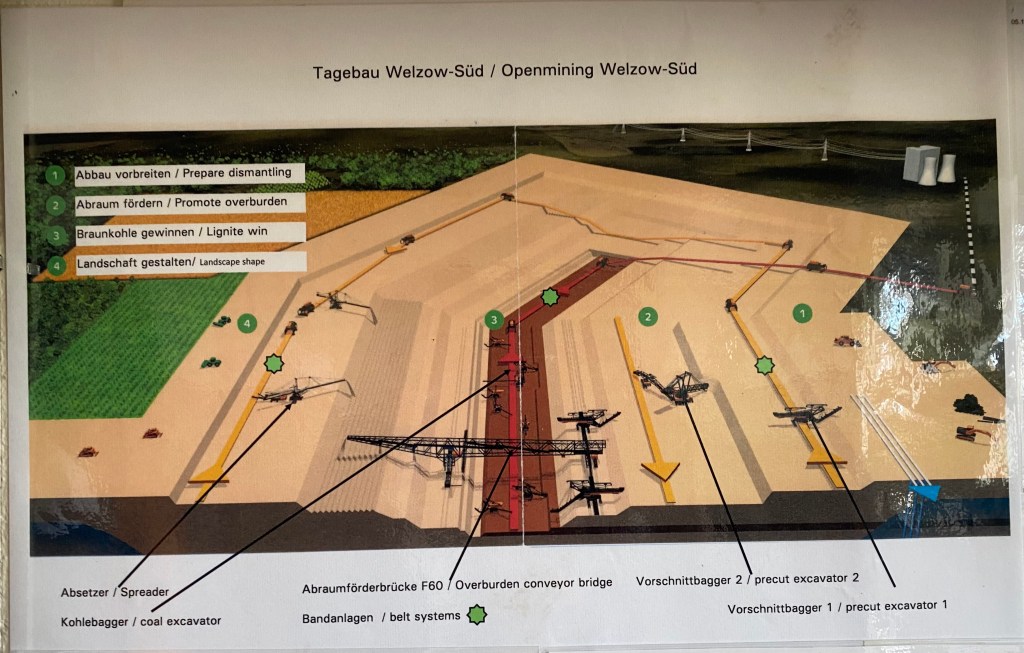
Image taken of diagram from the visitor center displays of the Welzow-Süd mine.
 May Ee Wong, PhD. Researcher and writer